
What Are the Classifications of Steel Structures?
Steel structure, as an important component in the field of modern construction, is widely used in various architectural and engineering structures due to its advantages of high strength, light weight, and good seismic resistance. As the basis for steel structure research and application, steel structure classification is of great significance for the rational selection of steel structure types and improving the design level of steel structures. This article will elaborate on the classification of steel structures, including classification according to connection methods, stress states, cross-sectional forms, etc.
1. Classification by connection method
(1) Welded steel structure: Welded steel structure is a structure formed by connecting steel materials through welding process. Welded steel structures have the advantages of high connection strength, good sealing, and compact structure. They are widely used in bridges, high-rise buildings, factories and other projects. However, problems such as welding residual stress and deformation may occur during the welding process, which need to be considered in design and construction.
(2) Bolted steel structure: Bolted steel structure is a structure that connects steel materials together through bolts and nuts. Bolted steel structures have the advantages of easy installation, flexible disassembly, and easy maintenance. They are suitable for occasions that require frequent replacement of components, such as steel structure workshops, exhibition halls, etc. However, bolted steel structures may have reduced connection performance due to loosening, corrosion, etc., and require regular inspection and maintenance.
2. Classification according to stress state
(1) Static steel structure: Static steel structure refers to a steel structure that works under static load. Static steel structure design requires that the structure has sufficient strength, stiffness and stability when bearing the design load to meet normal use requirements. Static steel structures are widely used in bridges, houses, towers and other projects.
(2) Dynamic steel structure: Dynamic steel structure refers to a steel structure that works under dynamic loads, such as earthquakes, wind loads, etc. The design of dynamic steel structures requires that the structure has good seismic and wind resistance properties when subjected to dynamic loads to ensure the safety and stability of the structure. Dynamic steel structures are commonly used in high-rise buildings, long-span bridges, towers and other projects.
3. Classification according to cross-sectional form
(1) Solid web steel structure: Solid web steel structure refers to a steel structure whose cross-section is entirely composed of steel, such as I-beam, channel steel, angle steel, etc. Solid web steel structures have the advantages of large cross-sectional area, good bending stiffness, and good stress performance, and are widely used in bridges, houses, towers and other projects. However, solid-web steel structures may produce large stress concentrations when subjected to stress, and their stress characteristics need to be considered during design.
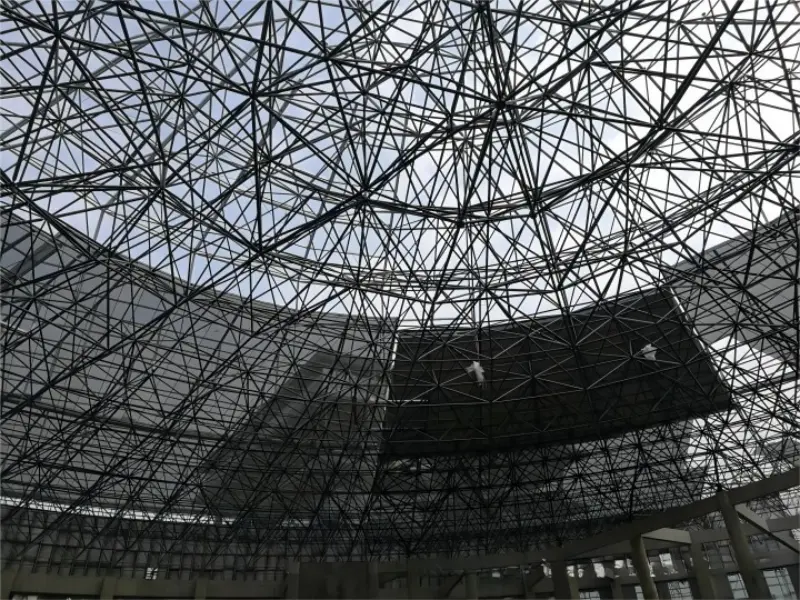
(2) Lattice steel structure: Lattice steel structure refers to an open-web steel structure composed of strips and panels, such as trusses, lattice columns, etc. The lattice steel structure has the advantages of light weight, low material consumption, and large span capacity. It is suitable for long-span bridges, high towers, transmission towers and other projects. However, the lattice steel structure may undergo large deformation when subjected to force, and its overall stability must be considered during design.
4. Other classification methods
In addition to the above common classification methods, steel structures can also be classified by use, material, manufacturing process, material thickness and other ways. For example, according to the use can be divided into building steel structure, bridge steel structure, tower steel structure and so on; According to the material can be divided into carbon steel structure, low alloy high strength steel structure, stainless steel structure; According to the manufacturing process, it can be divided into hot-rolled steel structure, cold-formed steel structure, welded H-shaped steel structure, etc. According to the thickness of the material can be divided into light steel structure and heavy steel structure. These classification methods help to further refine the application range of steel structures and improve the design level of steel structures.
In short, steel structure classification is the basis for steel structure research and application, and is of great significance for the rational selection of steel structure types and improving the design level of steel structures. In actual projects, appropriate steel structure types should be selected based on different engineering requirements, stress states, material conditions and other factors to ensure the safety, economy and aesthetics of the structure. At the same time, with the advancement of science and technology and the continuous accumulation of engineering practice, the classification and application of steel structures will continue to be updated and improved.
Glorysteelwork is system-level steel, metal material, and equipment supplier. Currently, our business covers six major sectors: raw materials, fasteners, forging, steel structures, rails, and equipment. In the fields of fasteners, rail systems, and lubrication systems, we have our own technical team, which can provide customers with additional services such as solution advice, installation guidance, and technical support. Welcome to purcuse!