
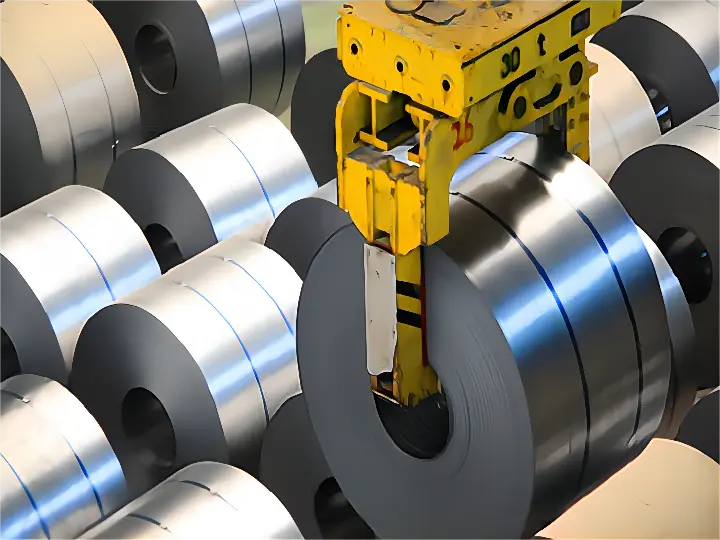
The Temperature Difference is More Than A Thousand Degrees: What is the Difference Between Hot Rolling and Cold Rolling?
Both hot rolling and cold rolling are processes for forming steel plates or profiles, and they have a great influence on the structure and properties of steel.
The rolling of steel is mainly hot rolling, and cold rolling is usually only used to produce small section steel and thin steel with precise dimensions.
Hot rolled
By definition, steel ingots or billets are difficult to deform and process at room temperature, and are generally heated to 2012℉-2282℉ for rolling. This rolling process is called hot rolling.
The termination temperature of hot rolling is generally 1472℉-1652℉, and then it is generally cooled in the air, so the hot rolling state is equivalent to normalizing treatment.
Most steel products are rolled by hot rolling method. Due to the high temperature, the steel delivered in the hot-rolled state has a layer of oxide scale on the surface, so it has certain corrosion resistance and can be stored in the open air.
However, this layer is iron oxide scale also makes the surface of the hot-rolled steel rough and the size fluctuates greatly. Therefore, the steel with smooth surface, accurate size and good mechanical properties is required to use hot-rolled semi-finished products or finished products as raw materials and then cold-rolled for production.
Advantage:
The forming speed is fast, the output is high, and the coating is not damaged. It can be made into a variety of cross-sectional forms to meet the needs of the use conditions; cold rolling can cause a large plastic deformation of the steel, thereby increasing the yield point of the steel.
Shortcoming:
1. Although there is no thermal plastic compression during the forming process, there are still residual stresses in the section, which will inevitably affect the overall and local bucking characteristics of the steel.
2. The steel of cold-rolled section steel is generally an open section, so that the free torsional stiffness of the section is low. It is easy to twist when it is bent, and it is easy to buckle when it is compressed, and its torsional performance is poor;
3. The wall thickness of the cold-rolled formed steel is small, and there is no thickening at the corner where the plates are connected, and the ability to withstand local concentrated loads is weak.
The hot coil is uncoiled, continuous welding begins, and the cold rolling process is formally entered: after pickling, it enters the rolling mechanism to produce hard rolled coils, and the cleaned hard rolled coils enter the heat treatment stage:
Annealing(taking bell furnace annealing as an example): hot rolling starts to charge to cold rolling, at this time the temperature MAX:1310℉, MIN:1184℉, and then spray cooling: 392℉-716℉
Annealing: before entering the finishing unit, the temperature has dropped to 40℉
Cold rolling
Cold rolling refers to the rolling method of extruding steel with the pressure of rolls at room temperature to charge the shape of steel. Although the process also heats up the steel plate, it is still called cold rolling. Specifically speaking, cold-rolled and hot-rolled steel coils are used as raw materials, and after pickling to remove scale, pressure processing is carried out, and the finished product is hard-rolled coils.
Generally, cold-rolled steel such as galvanized and color steel plate needs to be annealed, so the plasticity and elongation are also good, and it is widely used in automobiles, home appliances, hardware and other industries. The surface of the cold-rolled sheet has a certain smoothness that cannot meet the requirements, so the hot-rolled steel needs to be cold-rolled, and the thinnest thickness of the hot-rolled steel strip is generally 1.0mm, and the cold-rolled steel strip can reach 0.1mm. Hot rolling is rolling above the crystallization temperature point, and cold rolling is rolling below the crystallization temperature point.
The change of steel shape by cold rolling belongs to continuous cold deformation. The cold hardening caused by this process increases the strength and hardness of hard-rolled coils, and decreases the ductility and plasticity indicators.
For end use, cold rolling deteriorates the stamping performance, and the product is suitable for parts with simple deformation.
Advantage:
It can destroy the casting structure of the billet, refine the grains of the steel, and eliminate the defects of the microstructure, so that the steel structure is dense and the mechanical properties are improved. This improvement is mainly reflected in the rolling direction, so that the steel is no longer isotropic to a certain extent; the bubbles, cracks and looseness formed during pouring can also be welded under high temperature and pressure.
Disadvantages:
1. After hot rolling, the non-metallic inclusions (mainly sulfides and oxides, as well as silicates) inside the steel are pressed into sheets, and the stratification phenomenon occurs, which greatly worsens the performance of the steel along the thickness direction, and it is possible to tear between the layers when the weld is contracted. The local strain induced by weld contraction often reaches several times of the yield point strain, which is much larger than that caused by load.
2. Residual stress caused by uneven cooling. Residual stress is the internal self-equilibrium stress in the absence of external force. Hot-rolled steel of various sections has such residual stress. The larger the section size of general steel, the greater the residual stress. Although the residual stress is self-equilibrium, it still has a certain effect on the performance of steel members under external forces. Such as deformation, stability, anti-fatigue and other aspects may have adverse effects.
Summarize
The difference between hot rolling and cold rolling is mainly the temperature of the rolling process. “Cold” means normal temperature, and “hot” means high temperature.
From the point of view of metallogy, the boundary between cold rolling and hot rolling should be distinguished by the recrystallization temperature. That is, rolling below the recrystallization temperature is cold rolling, and rolling above the recrystallization temperature is hot rolling. The recrystallization temperature of steel is 842℉–1112℉.
The main differences between hot rolling and cold rolling are:
1. Appearance and surface quality:
Since the cold plate is obtained after the hot plate in the cold rolling process, and the cold rolling will also carry out some surface finishing, the cold plate is better than the hot plate in the surface quality (such as surface roughness, etc.). So if there are higher requirements for the coating quality of the product after the sequence of painting, generally choose the cold plate, and the hot plate is divided into pickling plate and unpickling plate. The surface of the pickling plate is a normal metallic color due to pickling, but the surface is not as high as the cold plate, and the surface of the unpickling plate usually has an oxide layer, hair black, or the existence of iron oxide black layer. In popular terms, it is like a fire, and if the storage environment is not good, it usually takes a little rust.
2. Performance:
Under normal circumstances, the mechanical energy of the hot plate and the cold plate in the project is considered to be no difference, although the cold plate in the cold rolling process there is a certain amount of work hardening, (but do not exclude the mechanical properties of strict requirements, it needs to be treated differently), the cold plate is usually slightly higher than the yield strength of the hot plate, the surface hardness is also higher, how to see the degree of cold plate annealing. But no matter how annealed cold plate strength is higher than hot plate.
3. Formability:
Because the performance of the hot and cold plate is basically the same, the influencing factors of the formability depend on the difference in surface quality. Because the surface quality is better than the cold plate, so generally speaking, the forming effect of the cold plate is better than that of the hot plate.