
Common Types of Steel and Their Applications—Classification and Main Uses of Square Steel
Glorysteelwork started from the production and sales of hot-rolled and cold-drawn profiles. Currently, its business covers six major sectors: raw materials, fasteners, forging, steel structures, rails, and equipment.
Common types of steel and their applications
1. Hot rolled coil
Hot rolled coil generally includes medium thickness wide steel strip, hot rolled thin wide steel strip and hot rolled sheet. The medium thick and wide steel strip is the most representative variety, and its output accounts for about two-thirds of the total production of hot rolled coil. Medium thick wide steel strip refers to thickness ≥3 mm and less than 20 mm, width ≥600 mm; Hot rolled thin and wide steel strip refers to the thickness < 3 mm, width ≥600 mm; Hot rolled sheet refers to a single sheet of steel with a thickness of < 3 mm.
Main use
Hot rolled coil products with high strength, good toughness, easy processing and good weldability and other excellent properties, are widely used in cold rolled substrate, ships, automobiles, Bridges, construction, machinery, oil pipelines, pressure vessels and other manufacturing industries.
2. Cold rolled sheet coil
The cold-rolled sheet coil consists of sheet and coil, which is rolled at room temperature and below the recrystallization temperature. Among them, the delivery of sheets is called steel plate, also known as box plate or plate; The long length and roll delivery are called steel belts, also known as roll plates. The thickness is 0.2-4mm, the width is 600-2000mm, and the length of the steel plate is 1200-6000mm.
Main use
Cold-rolled strip is widely used, such as automobile manufacturing, electrical products, rolling stock, aviation, precision instruments, food cans and so on. Cold plate is made of ordinary carbon structural steel hot rolled steel strip, after further cold rolling to make a thickness of less than 4mm steel plate. Due to rolling at room temperature, no oxide sheet is produced, cold plate surface quality is good, high dimensional accuracy, coupled with annealing treatment, its mechanical properties and process properties are better than hot-rolled sheet steel, in many fields, especially in the field of home appliance manufacturing, has gradually replaced hot-rolled sheet steel with it.
3. Medium thick plate
The medium plate refers to the steel plate with a thickness of 3-25㎜, the thickness of 25-100㎜ is called the thick plate, and the thickness of more than 100㎜ is the extra-thick plate.
Main use
Medium and thick plate is mainly used in construction engineering, machinery manufacturing, container manufacturing, shipbuilding, bridge construction and so on. It is used to manufacture various containers (especially pressure vessels), boiler shells and bridge structures, as well as automobile girder structures, ship shells for river and sea transportation, some mechanical parts, and can also be assembled and welded into large components.
4. Strip steel
In a broad sense, strip steel refers to all flat steel with a relatively long length that is delivered in roll form. In a narrow sense, it refers to the narrow width of the coil, that is, the usually called narrow strip steel and medium wide strip steel, sometimes especially narrow strip steel. According to the national statistical classification index, the coil below 600mm (excluding 600mm) is narrow steel strip or narrow steel strip. 600mm and above is a wide steel strip.
Main use
Strip steel is mainly used in the automotive industry, machinery manufacturing industry, construction engineering, steel structure, daily hardware and other fields, such as the production of welded steel pipes, cold-formed steel billets, manufacturing bicycle frames, rims, clamps, washers, spring blades, saw blades and so on.
5. Building Materials
(1) steel rebar
Rebar is the common name of hot-rolled ribbed steel bar, and the grade of ordinary hot-rolled steel bar is composed of HRB and the minimum yield point of the grade. H, R and B are the first letters of the words Hotrolled, Ribbed and Bars respectively. The seismic structure with higher requirements is suitable for the grade, which is to add the letter E after the existing grade (for example: HRB400E, HRBF400E).
Main use
Rebar is widely used in housing, Bridges, roads and other civil engineering construction. Large to highways, railways, Bridges, culverts, tunnels, flood control, DAMS and other public facilities, small to the foundation of housing construction, beams, columns, walls, plates, rebar are indispensable structural materials. At present, China is vigorously promoting the use of high-strength rebar, in order to meet the same strength and standard size, the use of three-level rebar than the two-level rebar to reduce steel consumption of about 11%-15%.
(2) High line
High-speed wire, referred to as “high wire”, is a kind of wire, usually refers to the “high-speed twist-free mill” rolled out of small specifications of wire, common low carbon steel twist-free cold and hot rolled wire (ZBH4403-88) and high-quality carbon steel twist-free cold and hot rolled wire (ZBH44002-88). The rolling speed is very high (at 80-160 m/s), and the disk weight is 1.8-2.5 tons.
Main use
High line is widely used in automobile, machinery, construction, home appliances, hardware tools, chemical industry, transportation, shipbuilding, metal products, nail products and other industries. Specifically, it is used to manufacture bolts, nuts, screws and other fasteners, prestressed steel wire, steel strand wire, spring steel wire, galvanized steel wire, etc.
(3) Round steel
Round steel, also known as “bar”, refers to a long solid steel bar with a circular cross-section. Its specifications are expressed in millimeters of diameter, for example: “50” means round steel with a diameter of 50 millimeters. Round steel is divided into hot rolled, forged and cold drawn three kinds. Hot rolled round steel is 5.5-250 mm in size.
Main use
5.5-25 mm small round steel is mostly supplied in straight strips in bundles, commonly used as steel bars, bolts and various mechanical parts; Round steel larger than 25 mm, mainly used for the manufacture of mechanical parts or seamless steel blanks.
6. Profiles
(1) Flat steel
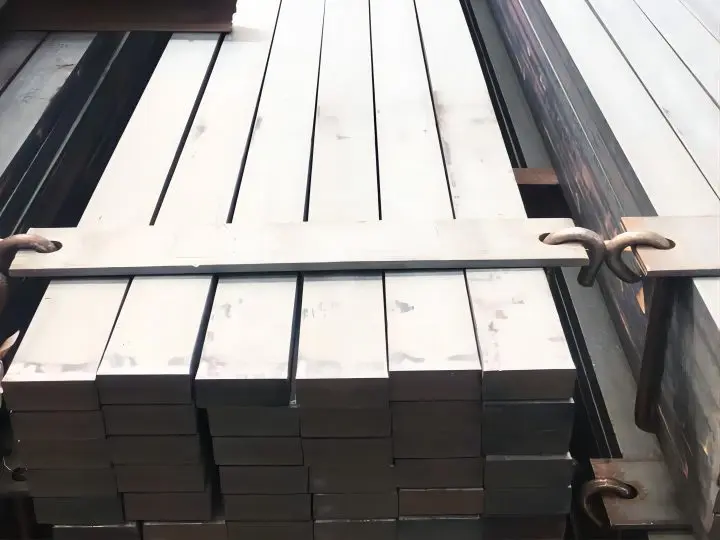
Flat steel refers to a steel with a width of 12-300㎜, a thickness of 4-60㎜, a rectangular section and a blunt edge, which is a kind of profile.
Main use
Flat steel can be used as finished steel, used for hoop iron, tools and mechanical parts, and used as structural parts in construction. It can also be used as billet for welding pipe and thin slab for rolling sheet. Spring flat steel can also be used to assemble laminated springs for cars.
(2) Square steel
Square section of steel, divided into hot rolled and cold rolled (cold drawing) two categories, common products to cold drawing. The side length of hot rolled square steel is generally 5-250mm. Cold drawn square steel to use high-quality carbide mold processing, the size is smaller, but the surface is smooth, high precision, the side length is 3-100mm.
Main use
Rolled or machined steel with a square cross-section. It is mostly used in mechanical manufacturing, making tools and molds, or processing spare parts. In particular, the surface condition of cold-drawn steel is good, and it can be directly used, such as spraying, sanding, bending, drilling, and direct plating, which eliminates a lot of machining time and saves the cost of configuring processing machinery.
(3) Channel steel
Channel steel is a long strip of steel with a groove section, divided into hot-rolled ordinary channel steel and cold-formed light channel steel. The specifications of hot-rolled ordinary channel steel are 5-40#, and the specifications of hot-rolled flexible channel steel supplied by the agreement between the supply and demand parties are 6.5-30#. Cold-formed channel steel can be divided into four kinds according to the shape: cold-formed equilateral channel steel, cold-formed non-equilateral channel steel, cold-formed inner wound channel steel, cold-formed outer wound channel steel.
Main use
Channel steel can be used alone, and channel steel is often used in combination with I-steel. Mainly used in the production of building steel structures, vehicle manufacturing and other industrial structures.
(4) Angle steel
Angle steel, commonly known as Angle iron, is a long strip of steel that is perpendicular to each other and angular. Angle steel is a carbon structural steel for construction, is a simple section of the section steel, in the use of good weldability, plastic deformation properties and a certain mechanical strength. The raw steel billet for producing Angle steel is low-carbon square steel billet, and the finished Angle steel is hot-rolled.
Main use
Angle steel can be composed of various metal components with different forces according to different needs, and can also be used as a connection between components. Angle steel is widely used in various building structures and engineering structures, such as house beams, plant frames, Bridges, power lines, lifting and transportation machinery, ships, industrial furnaces, reaction towers, container racks and warehouse shelves.
7. Pipes
(1) Steel pipe
Welded steel pipe, referred to as welded pipe, is made of steel plate or steel strip after bending and forming, and then welded. According to the form of weld, it is divided into straight seam welded pipe and spiral welded pipe. Under normal circumstances, the welded pipe refers to these two types of hollow circular section steel pipes, and other non-circular steel pipes are called special-shaped pipes.
Steel pipe to carry out water pressure, bending, flattening and other experiments, there are certain requirements on the surface quality, usually the delivery length is 4-10m, often require fixed size (or double size) delivery. The welded pipe has two kinds of ordinary steel pipe and thickened steel pipe according to the specified wall thickness, and the steel pipe is divided into two kinds of threaded buckle and no threaded buckle according to the form of the pipe end, and the continuous laying of multi-purpose with threaded buckle.
Main use
According to the use, it is often divided into general fluid transfer welded pipe (water pipe), galvanized welded pipe, oxygen blown welded pipe, wire casing, roller pipe, deep well pump pipe, automobile pipe (drive shaft tube), transformer pipe, electric welding thin-wall pipe, electric welding shaped pipe, etc.
(2) Spiral tube
The strength of spiral welded pipe is generally higher than that of straight welded pipe, and welded pipe with larger diameter can be produced with narrower billet, and welded pipe with different diameter can also be produced with billet of the same width. However, compared with the same length of straight seam welded pipe, the weld length is increased by 30-100%, and the production speed is relatively low. Therefore, the smaller diameter welded pipe is mostly straight seam welding, and the large diameter welded pipe is mostly spiral welding.
Main use
SY5036-83 is mainly used for pipelines transporting oil and natural gas; SY5038-83 Welded with high frequency lap welding method, spiral seam high frequency welded steel pipe for pressure fluid transport, steel pipe has strong bearing capacity, good plasticity, easy to weld and process forming. SY5037-83 adopts double-sided automatic submerged arc welding, or single-side welding method, for conveying water, gas, air and steam and other general low pressure fluids.
(3) Square pipe
Square pipe is a steel pipe with equal side length (square rectangular pipe with different side length), which is a strip steel after unpacking and process treatment, then flat, crimped, welded to form a round tube, and then rolled into a square tube by the round tube, and finally cut into the required length. The market packaging is usually one pack of 50 sticks.
Main use
Most of the square pipes are steel pipes, which are mostly used as structural square pipes, decorative square pipes, construction square pipes, etc.
8. Plating
(1) Galvanized sheet coil
It refers to the steel plate coated with a layer of zinc on the surface, and the galvanized steel plate is a widely used, economical and effective anticorrosion method. Galvanized sheet was used to be called “white iron sheet” in the early years. The delivery status is divided into two types: roll and plate.
Main use
According to the production process can be divided into hot galvanized sheet and electrogalvanized sheet. The zinc layer thickness of hot galvanized sheet is thicker, which is used to make parts with strong corrosion resistance for open air use. The zinc layer thickness of electrogalvanized sheet is thin and uniform, and it is mostly used for painting or making indoor supplies.
(2) Color coated plate roll
Color coated coil is a product of hot galvanized plate, hot aluminum plated zinc plate, electrogalvanized plate, etc., after surface pretreatment (chemical degreasing and chemical conversion treatment), coated with one or several layers of organic coating on the surface, and then baked and cured. Also because coated with a variety of different colors of organic paint color steel coil thus named, referred to as color coated coil.
Main use
In the construction industry, roofs, roof structures, rolling shutter doors, kiosks, shutters, guard doors, street waiting rooms, ventilation channels, etc.; Furniture industry, refrigerator, air conditioner, electronic stove, washing machine shell, oil stove, etc.; Transportation industry, automobile ceiling, backboard, coaming, car shell, tractor, ship compartment board, etc. Among these uses, the most used are steel structure plant, composite board plant, color steel tile plant.
Glory Rail is system-level steel, metal material, and equipment supplier. It is engaged in steel trading, processing, and production for more than 20 years. The raw materials of our entire supply system have strict quality control to ensure that the products have higher quality than the market.
Through a scientific and efficient management system, supply costs are reduced, and customer operating costs are reduced throughout the entire supply process.