
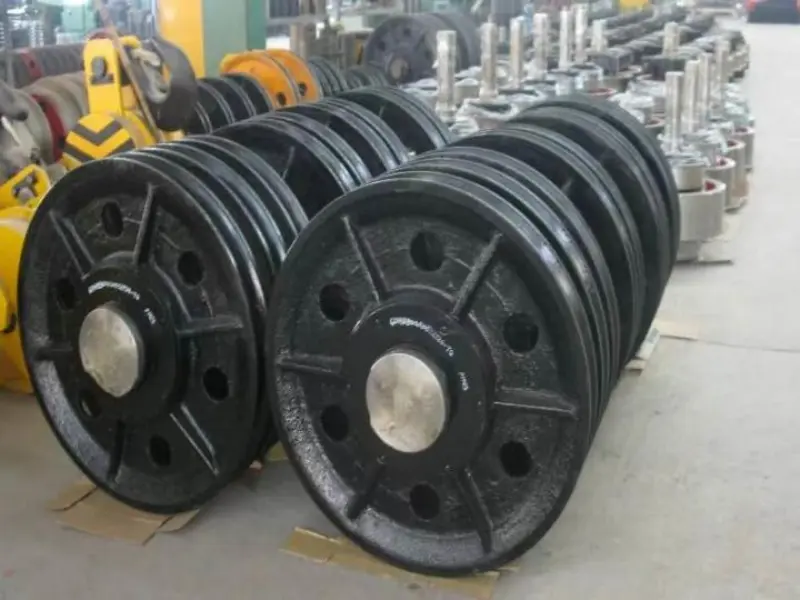
The Difference Between Cast Pulley and Forged Pulley
Pulley (also called rope wheel) products are simple mechanical parts to lift heavy objects and save effort, the function is to pull the load, change the direction of force, transmission power, etc. The typical structure of the whole set of pulley parts is composed of rim, spoke, hub, bearing, dust cover, spacer, expansion ring and so on. The shape of the pulley is a small wheel with grooves around the perimeter that can be rotated around the shaft. A simple machine consisting of a grooved disc that rotates around a central axis and a flexible cable (rope, tape, cable, chain, etc.) that crosses the disc that rotates around a central axis is called a pulley.
According to the manufacturing process is divided into: casting pulley, welding pulley, double plate pressing pulley, forging pulley, rolling pulley.
Forged pulley
It is a processing method that uses forging machinery to exert pressure on pulley metal billet to produce plastic deformation to obtain forgings with certain mechanical properties, certain shapes and sizes, and is one of the two components of forging (forging and stamping). Through forging can eliminate the metal in the smelting process of the as-cast loose and other defects, optimize the microstructure, and because of the preservation of the complete metal flow line, the mechanical properties of the forgings are generally better than those of the same material. For important parts with high load and severe working conditions in related machinery, forgings are mostly used in addition to plates, profiles or welding parts with simple shapes that can be rolled.
Compared with the cast pulley, the forged pulley improves its organizational structure and mechanical properties after forging processing. The deformed pulley after hot processing makes the raw materials crystallize and changes the original coarse dendrites and columnar grains into crystalline structures with finer grains and uniform sizes, which makes the organization in the pulley more compact and improves the physical properties of the pulley. The appearance and roughness of the pulley forgings after processing are more beautiful, smooth and durable than the casting pulley, and the only certainty is that the process cost accounting is more expensive than the casting pulley. However, for important high-quality, high-strength large cranes or other models, more pulley forgings are chosen.
Cast pulley
Casting pulley is a process in which metal is melted into metal liquid that meets certain requirements and poured into the cast mold, and the predetermined shape, size and performance of the pulley are obtained after cooling and solidification and cleaning treatment. The casting pulley blank is almost formed, so as to achieve the purpose of no mechanical processing or small processing, which reduces the cost and reduces the production time to a certain extent. Pulley casting is the basic technology of modern device manufacturing industry.
Compared with forged pulley, it can produce pulley parts with complex shape, especially the pulley blank with complex inner cavity. Wide adaptability, low cost; The source of raw materials is wide, the price is low, and the shape and size of the pulley casting are very close to the parts, which reduces the cutting amount and belongs to the non-cutting processing. The disadvantage is that the mechanical properties are not as good as pulley forgings, such as thick organization and many defects; Sand casting, single piece, small batch production, workers labor intensity; The quality of pulley casting is unstable, the process is many, the influencing factors are complex, and it is easy to produce many defects.