
Why Are Rails Designed with an I-Section?
1. Why Rail Profile Design Matters
Rail profile design is not just about geometry. It directly affects safety, durability, and operating cost. Rails guide wheels, carry heavy loads, and transfer forces to sleepers and the track foundation.
If the profile is poorly designed, wear increases, maintenance costs rise, and train stability suffers.
For modern railways, industrial lines, and crane tracks, the I-section rail has become the global standard. It offers a practical balance between strength, material efficiency, and long-term reliability.
2. The I-Section Rail: Practical Engineering Logic
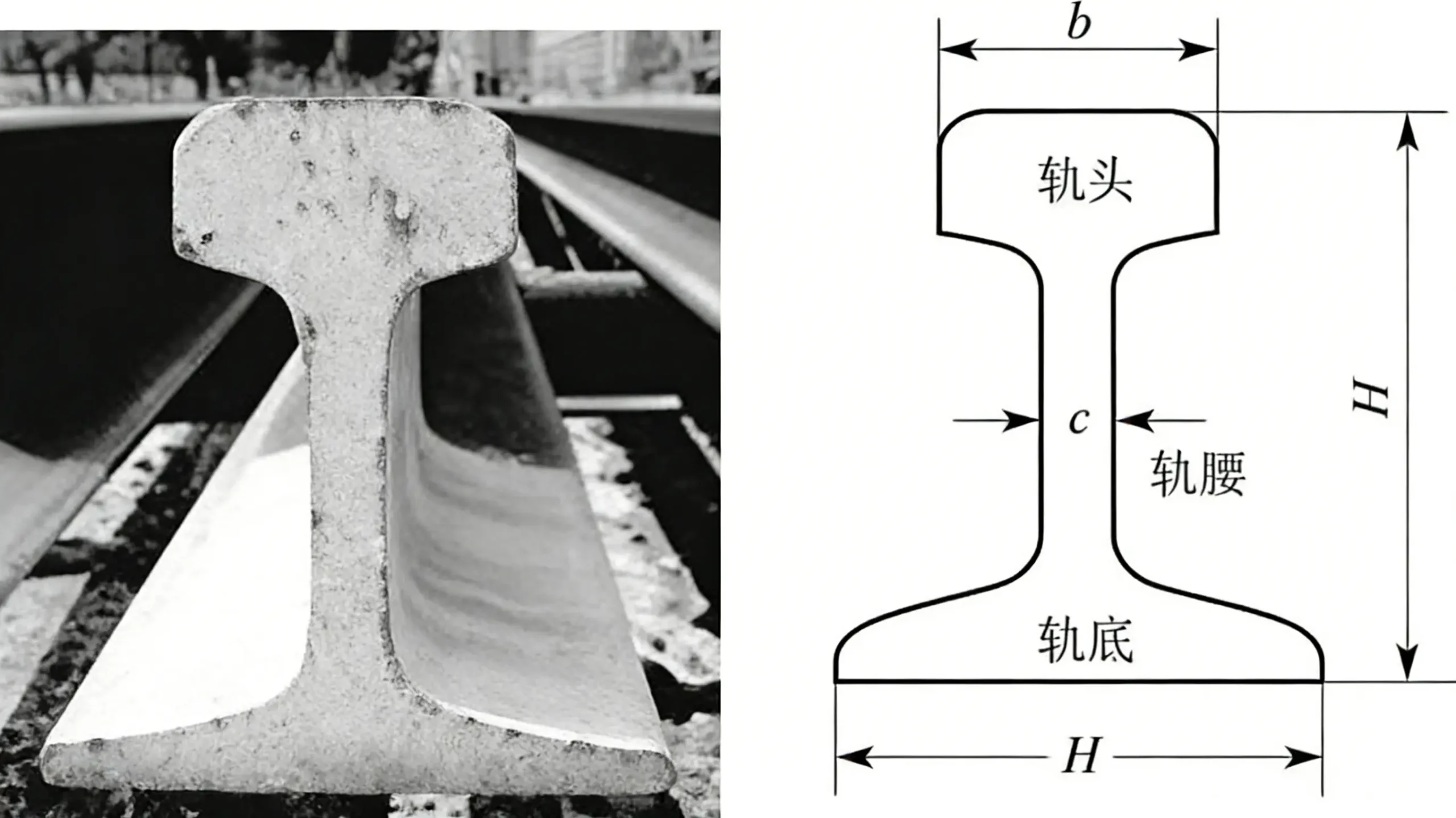
The head, web, and base are the three primary components of an I-section rail. Each portion provides a distinct mechanical role.
Rail Head
The rail head contacts the wheel directly. Its form prevents wear and facilitates smooth wheel movement. A well-sized head enhances stability in heavy traffic, decreases rolling resistance, and extends service life.
Rail Web
The head and base are joined by the web. It resists shear and bending stresses and transfers vertical loads downward. Its height and thickness are engineered to withstand repeated axle loads without permanently deforming.
Rail Base
The base is wider than the head. It distributes the weight among the track bed and sleepers. When combined with fasteners, it maintains the rail’s stability and stops it from tipping or moving laterally when subjected to dynamic stresses.
This layout places steel where stress is highest. The result is high strength without unnecessary weight. Compared with other profiles, the I-section delivers better bending resistance and structural stability while using material efficiently.
3. Load Resistance and Material Efficiency
Rails experience extreme forces during operation. A fully loaded freight train can apply thousands of tons of pressure to a single track. The I-section resists bending effectively and keeps the rail aligned under these loads.
Modern rail designs typically distribute steel as follows:
- about 42% in the head
- around 21% in the web
- roughly 37% in the base
Engineers refined these proportions through decades of testing and real-world use. This balance maximizes steel performance, reduces waste, and supports demanding conditions. It works equally well for high-speed rail lines and repetitive crane movements in ports and industrial facilities.
4. I-Section vs. Other Profiles
Other rail cross-sections exist in theory, but they show clear weaknesses in practice.
L-section rails lack balance and bending resistance. They cannot support heavy axle loads reliably.
T-section rails offer limited vertical load capacity and lower structural efficiency.
The I-section combines strength, stability, and ease of manufacturing. It also simplifies handling, transport, and installation. These advantages explain why it remains the preferred rail profile worldwide.
5. Historical Context and Continuous Improvement
In 1830, American engineer Robert L. Stevens invented the I-section rail. The fundamental shape hasn’t changed since then. Rather than rebuilding the cross-section, engineers concentrated their efforts on steel grades, heat treatment, and head shape.
This lengthy history demonstrates the efficacy of I-sections. It functions dependably in a variety of railroad and industrial settings, supports large loads, and is resistant to wear.
6. The Implications for Contemporary Rail Project
Engineers and procurement teams may select the appropriate rail for each application by comprehending the reasoning behind the I-section. Typical usage cases include:
- heavy-duty mainline railroads
- Crane and industrial rail systems
- Logistics terminals and ports
Best performance comes from matching the rail profile, steel grade, and installation conditions. Ignoring these principles frequently results in increased safety concerns, lower service life, and higher maintenance expenses.
7. Glory Steel Work – Your Rail Partner
At Glory Steel Work, we supply high-quality I-section rails for railway and industrial projects worldwide. Our products meet AREMA, EN, and GB standards. We offer:
- multiple steel grades for different load and wear conditions
- custom processing such as cutting, drilling, bending, and surface treatment
- ready stock and coordinated logistics for fast delivery
- technical support to match rails to specific project requirements
With decades of experience, we combine engineering knowledge with production capacity to deliver reliable, project-ready rail solutions.
8. Conclusion
The I-section rail remains the global standard because it delivers strong load resistance, efficient material use, and long-term reliability. Understanding its design helps project teams make better decisions, reduce operating costs, and improve safety.
Glory Steel Work is ready to support your projects with proven rail solutions, technical expertise, and dependable supply.