
Exploring the 8 Common Types of Rail Joints for Industrial & Crane Tracks
Rail joints are among the most critical components in rail systems, whether for heavy cranes, port logistics, mining facilities, or general infrastructure. They connect two rail sections, absorb repeated wheel impacts, resist lateral and longitudinal forces, and accommodate thermal expansion and contraction caused by temperature changes.
A weak or improperly selected joint can accelerate wear, increase vibration, and even threaten operational safety. Therefore, understanding the different types of joint bars helps engineers and project managers choose the right solution for their specific working conditions.
Below we introduce 8 main types of joints and their applications in industrial and crane rail projects.
1. Standard Rail Joints
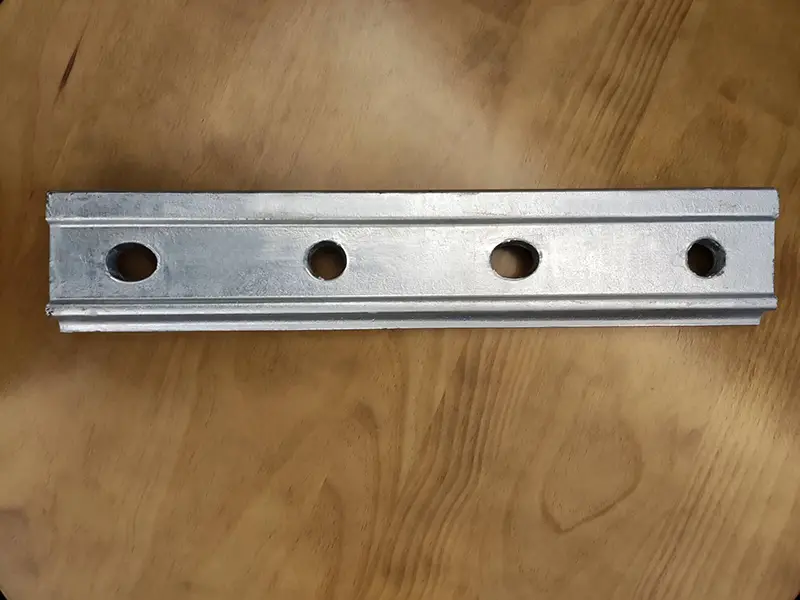
Standard rail connectors are the most commonly used connection in conventional rail and crane track systems. They typically consist of fishplates (joint bars), high-strength bolts, nuts, and spring washers.
This simple and reliable structure connects rail ends securely while maintaining track stability. It supports vertical loads, resists bending and lateral displacement, and allows limited thermal movement to prevent rail buckling.
Double-headed fishplates are widely used in heavy-duty applications due to their higher rigidity and better resistance to deflection under heavy crane or vehicle loads.
2. Insulated Rail Joints
Insulated joints are designed for rail systems that require electrical isolation, such as automated rail lines, signaling sections, and track circuit systems.
By installing high-performance insulating materials between rail ends, fishplates, and bolts, these joints prevent electrical current from passing between adjacent rail sections. Consequently, they ensure accurate signal transmission and stable control system operation.
They are widely applied in railways, automated yards, intelligent ports, and modern industrial transportation systems.
3. Frozen Rail Joints
Frozen joints are used to tighten and lock rail ends to minimize or restrict thermal movement. Using high-strength fishplates and bolts, they clamp rails tightly with little or no gap, limiting expansion and contraction.
There are two main categories:
- Conventional frozen joints: Use special gaskets to fill bolt holes and eliminate gaps for tight fitting.
- Advanced frozen joints: Use high-strength anti-loosening bolts, Huck fasteners, or specialized locking systems to create strong friction between rails and splints. This effectively restrains rail movement and reduces maintenance.
Frozen joints provide performance close to seamless rails and are ideal for high-stability track sections.
4. Bonded Rail Joints
Bonded joints, often used as bonded insulated joints, combine insulation and integrated bonding for long seamless rail lines. They are usually prefabricated in factories or assembled on-site for improved durability.
In addition, compared with standard insulated joints, bonded joints distribute stress more evenly, enhance load capacity, and extend service life.
They can be constructed as butt joints or miter joints. Butt joints are simpler, more reliable, and more widely used in actual engineering.
5. Special-Shaped Transition Joints
When connecting two different rail types or weights — such as 50kg/m rail and 60kg/m rail, or different crane rail profiles — standard joints cannot be used. Instead, special-shaped transition joints are applied.
These joints use custom fishplates and profiled rail ends to match different cross-sections. Accurate alignment of the rail top and gauge line is essential to ensure smooth and safe passing of wheels.
They are commonly used in track reconstruction, yard upgrades, and mixed-rail crane systems.
6. Expansion Joints
Expansion joints are designed to absorb large thermal displacements, especially on long bridges, viaducts, and long seamless tracks often over 100 meters.
They consist of a base rail, a sliding switch rail, a long tie plate, and special fasteners. During temperature changes, the switch rail slides along the base rail to compensate for elongation or contraction while maintaining alignment.
Based on the switch rail shape, they can be divided into angular and curved expansion joints, making them essential for bridge tracks and lines in extreme climates.
7. Vibration-Damping Rail Joints
Vibration-damping joints, also known as bearing-type joints, reduce wheel-rail impact, noise, and vibration. The fishplate is designed to be nearly level with the rail head, so loads are shared between the rail and the joint bar.
This structure reduces the “step effect” at joints, minimizes impact forces, and improves running smoothness. As a result, they suit urban industrial areas, ports, and sites with strict noise and vibration requirements.
8. Welded Joints
Welded joints are used to form continuous welded rail (CWR), the most stable and low-maintenance rail connection available. Rails are permanently joined using professional welding methods:
- Flash welding
- Gas pressure welding
- Thermite welding
Welded joints provide mechanical properties similar to the original rail and eliminate gaps, greatly reducing wear, vibration, and maintenance. For many heavy-duty crane rails and special-profile crane rails, welded connections are strongly recommended.
Conclusion
Different rail joints serve different functions, from basic connection and insulation to thermal control, transition, noise reduction, and seamless performance. Therefore, selecting the best joint depends on your application, load conditions, environment, and maintenance plan.
At GloryRail, we supply a full range of high-quality crane rails, steel rails, fishplates, fasteners, and customized rail joint solutions for global industrial customers. Our technical team supports rail selection, joint design, and project optimization for cranes, ports, mines, and infrastructure projects.
If you need professional advice on rail connectors or rail system solutions, welcome to contact GloryRail for reliable products and technical support.